What Savina is
Savina is a Serbian Orthodox monastery on a wooded ridge directly above Meljine, on the eastern side of Herceg Novi. It is the most important religious complex in the town and one of the more interesting monastic sites on the Montenegrin coast, both for its architecture, three distinct churches on one site, and for a treasury that holds manuscripts, liturgical objects and icons from the 14th century onwards.
The oldest building is the Small Church of the Dormition (Mala crkva Uspenja), which dates in its current form to around the late 16th century, though parts of the fabric are older. Its interior is covered with 18th-century frescoes by the painter Simeon Lazović, who was part of the late-Baroque school of Serbian church painting. The Large Church (Velika crkva), the main building you see first on arrival, was built between 1777 and 1799, a late-18th-century Serbian-Orthodox church with a restrained classical façade and a tall separate belfry. The third and smallest building is the Church of Saint Sava, a 14th-century chapel on the upper terrace of the complex.
The treasury
The Savina treasury (riznica) is normally shown to visitors on request. It contains manuscripts including a 14th-century gospel associated with Saint Sava, liturgical vestments, a collection of silver crosses, and a number of icons painted by masters of the Boka school, a distinctive 17th-18th century iconographic tradition native to the Bay of Kotor. A visit to the treasury is brief (20-30 minutes) but genuinely worthwhile if you have spent time in larger European museum collections and want to see something with a clear local thread.
Treasury access depends on the presence of a monk and on the day's schedule. Calling ahead is difficult, the monastery does not operate a formal booking system, but arriving mid-morning on a non-feast-day weekday gives you the best chance. A modest donation is appreciated.
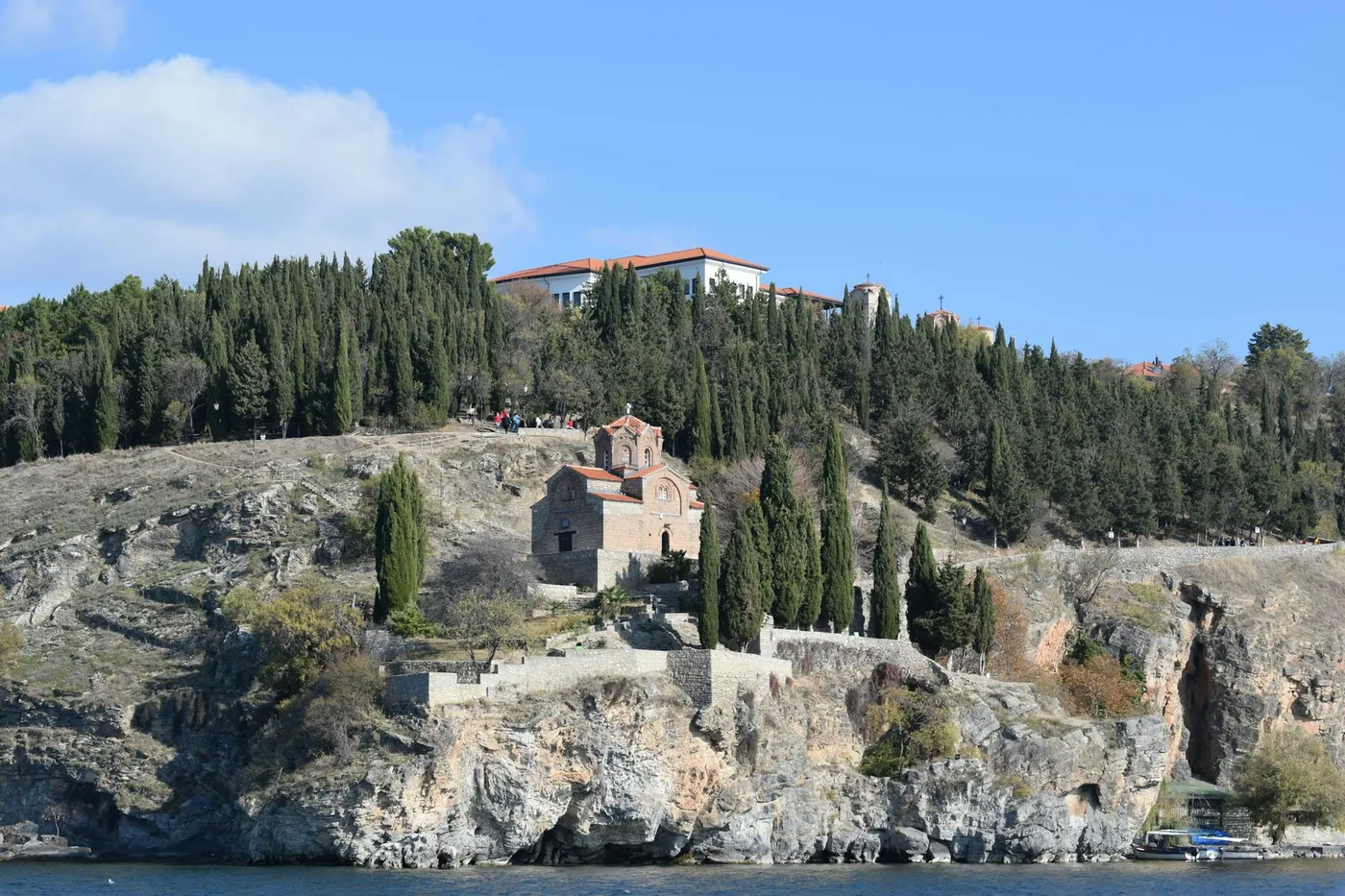
The backroad drive up
The standard approach is the signed turn off the main coastal road at Meljine, which climbs directly to the monastery car park in about five minutes. That works fine. The more interesting drive is to start earlier and take the old road that winds through the Meljine neighbourhoods. From the main road, turn inland at the hospital and follow the narrow lanes uphill through gardens, small vineyards, and the occasional flock of goats. The old road is single-lane asphalt for most of its length, with passing places, and emerges at the monastery from above rather than below. Allow 15-20 minutes from the coast road via this route, versus five by the signed approach.
The backroads connect to the same hill country used by the olive producers, see the olive tasting guide for background, and it is straightforward to combine a monastery visit with an olive tasting on the same morning.
Walking the complex
The monastery grounds are terraced into the hillside. On arrival, the Large Church dominates the view with its belfry. To its side and slightly below sits the Small Church, which is usually the more rewarding interior, lower, cooler, frescoed on every surface. Above the Large Church, past an ancient cypress that the monks say is over 250 years old, is the small Saint Sava chapel. Benches in the gardens look out over Herceg Novi and the bay; this is one of the best mid-altitude views of the western part of the bay you can reach by car.
Dress is modest: covered shoulders, knees, no short skirts or shorts. Wraps are sometimes available at the entrance. Hats off inside the churches. Photography is permitted in the grounds and exterior; inside the churches, ask first, icon photography is generally not allowed.
Opening hours and timing
The church complex is open daily, usually from around 08:00 to 19:00 in summer with shorter hours in winter. Services are held on Sundays and major feasts and visitors are welcome to observe quietly. The liturgical singing, often led by a handful of monks, is striking. Mid-morning on a weekday is the quietest time for a proper walk around.
Avoid major Orthodox feast days if you want a quiet visit. The monastery becomes a pilgrimage destination and parking overflows down the approach road.
Practical tips
- Parking: Free lot below the monastery. Can fill on Sundays and feast days.
- Dress: Shoulders and knees covered. Wraps available at the entrance.
- Treasury: Ask at the church shop on arrival, it is not always open but a small donation and a little patience usually work.
- Quiet: This is an active monastery. Keep voices low, especially inside the churches.
- Combine with: An olive tasting in the hills above, or a walk down through the stepped alleys of the old town.