Why there are three
Herceg Novi was founded in 1382 by the Bosnian king Tvrtko I as a salt-trading town (Sveti Stefan, later "Novi"). Over the next four centuries it changed hands repeatedly: Herceg Stjepan Vukcic, the Ottomans (from 1482), the Spanish (very briefly, 1538), the Venetians (1687-1797), the French, the Austro-Hungarians, and eventually the Yugoslav and Montenegrin states. Each occupier built, rebuilt or expanded fortifications on the hillside above the bay mouth, because the bay mouth was the strategic point. What you see today is three distinct fortresses, each from a different era, stacked roughly vertically from the shore to the ridge.
Forte Mare, the shore fortress
Forte Mare sits right on the water, guarding the harbour. Its foundations are 14th-century Bosnian but the shape you see today is largely Venetian, reworked between 1687 and 1797. It has the classic angular Venetian bastion geometry designed for cannon rather than medieval siege. Inside, the central courtyard was converted into an open-air cinema in the Yugoslav period and the tradition continues, summer film screenings under the walls are part of the Herceg Fest calendar. Entry is a few euros, open daily through the summer with shorter winter hours.
Kanli Kula, the Ottoman prison-fortress
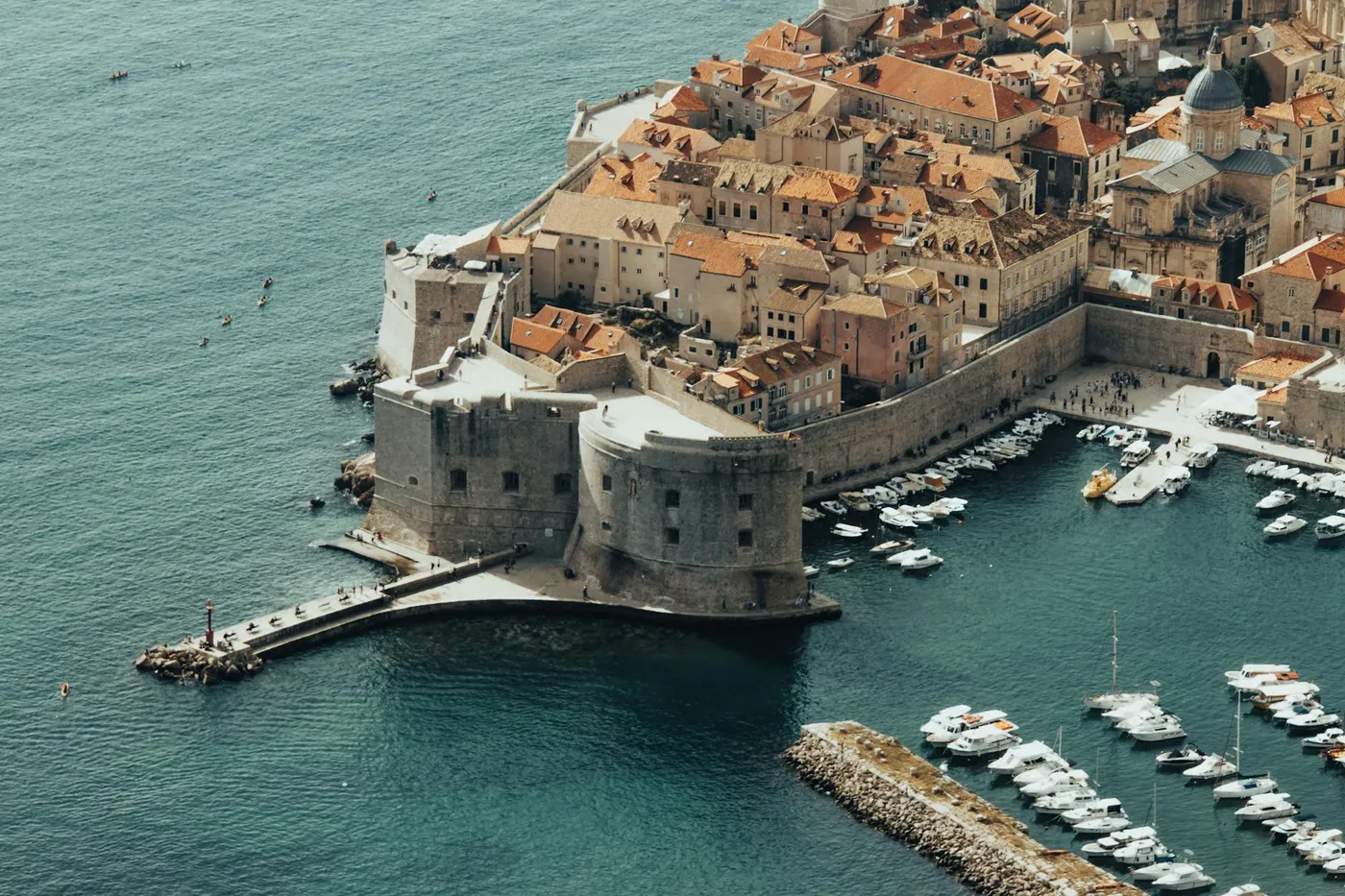
"Kanli Kula" means "Bloody Tower" in Turkish, and the name is earned. Built in the 16th century during Ottoman rule, it served primarily as a prison until well into the 20th century. You can still see graffiti scratched into the walls of the inner cells by prisoners, names, dates, crude ships, though the most photographed examples are behind glass now. The footprint is large: two massive drum bastions joined by a curtain wall, enclosing a courtyard that the Yugoslav authorities converted into a 1,000-seat stone amphitheatre in the 1960s. It is still used for concerts and performances.
From the outer walls the view covers the entire bay mouth, from Prevlaka on the Croatian side east to Lustica. Entry is typically EUR 2-3. Plan 30-45 minutes.
Spanjola, the Spanish fort on the ridge
Above the old town, on the ridge at around 170 m altitude, sits Spanjola. The name records the brief Spanish occupation of 1538, when Charles V's forces took Herceg Novi and began work on a ridge fortress before losing the town back to the Ottomans in 1539. The structure you see was substantially completed by the Ottomans and modified later by the Austrians. It is open, unguarded, free to enter, and in a noticeably rougher state than the other two, crumbling walls, grass growing through the flagstones, occasional scaffolding.
The reward for the climb is the view. Spanjola looks directly down the throat of the bay, with Mamula Island and the open Adriatic to the west, the bay narrows toward Kotor to the east, and the Orjen limestone wall rising behind you. Bring water; there is no shade and no cafe.
The walking route, shore to ridge
Start at Forte Mare on the harbour. Tour it, then leave through the Sea Gate and climb through the old town squares. From Belavista, the stepped alleys lead up to Kanli Kula (15-20 minutes of climbing). From the upper gate of Kanli Kula, the old road continues uphill past private houses to Spanjola, a further 20-30 minutes on a mix of paved and unpaved surfaces. Total walking time with fortress stops: around four hours. It is exactly the kind of day that links naturally with the staircase walk up through the old town.
History walks, not battlefields
None of these fortresses saw the kind of dramatic siege that would make them famous outside the region. They changed hands mostly through treaty and the slow turn of empires, Treaty of Passarowitz, Treaty of Campo Formio, Congress of Vienna, and so on. What is on display is occupation architecture: how one power modifies the fabric of the previous. Venetian lions carved over Ottoman gates, Ottoman fountains inside Venetian courtyards, Austrian numberplates on Ottoman doors. That layering is the real reason to visit.
Practical tips
- Order: Bottom to top, always. Forte Mare, then Kanli Kula, then Spanjola. You will want the downhill walk back after Spanjola.
- Tickets: Small cash fees at Forte Mare and Kanli Kula. Spanjola is free.
- Opening hours: Both ticketed forts are open daily in summer, shorter hours in winter, check locally.
- Shoes: Trainers with grip. The upper road to Spanjola is broken in places.
- Summer heat: Start by 09:00. Midday on Kanli Kula's exposed walls in July is not enjoyable.
- Camera: Morning light is better for east-facing Kanli Kula; late afternoon for west-facing Spanjola.